Reviewed 2026-10-02Town comparison

Peso da Régua or Pinhão: which Douro base fits?

Régua is the connected base: about twice Pinhão's daily trains from Porto, the quay that boats from Porto reach, and a full town. Pinhão is the Cima Corgo village base for quinta days and quiet evenings, with fewer trains to plan around.

Decision rules

  • Without a car, on a Porto boat day or on the historic train, choose Régua; for Cima Corgo quintas and a quiet village night, choose Pinhão.
  • Book within an easy walk of the station or quay you will actually use, and check that walk with luggage before paying.
  • Keep one base on a short trip: the other town is about 25 minutes away by train.

Choose Régua for connections and a full town

Visit Portugal ties Régua's growth to the 1756 demarcation and the Port trade toward Gaia. Today it is a city and municipal seat with the line's busier station, the river quay boats from Porto reach and the Museu do Douro beside it. It suits rail-only trips, later arrivals, boat days and anyone who wants evening choice.

Choose Pinhão for a Cima Corgo village night

Alijó municipality counts about 620 residents in Pinhão, flanked by the Douro and Pinhão rivers in the heart of the demarcated region. The station, with 24 tile panels of more than 3,000 azulejos, and the river quays sit a short walk apart. It suits estate-focused stays and slow evenings, provided the fewer trains and dinner plans are settled first.

Split the stay only when two anchors need it

The towns are about 25 minutes apart by train and 27 km apart on the riverside EN222, so one base plus a half-day in the other usually beats moving luggage. Split only for separate booked anchors, such as a boat arrival at Régua followed by confirmed estate days around Pinhão.

See the two bases

Two river towns, two different stays.

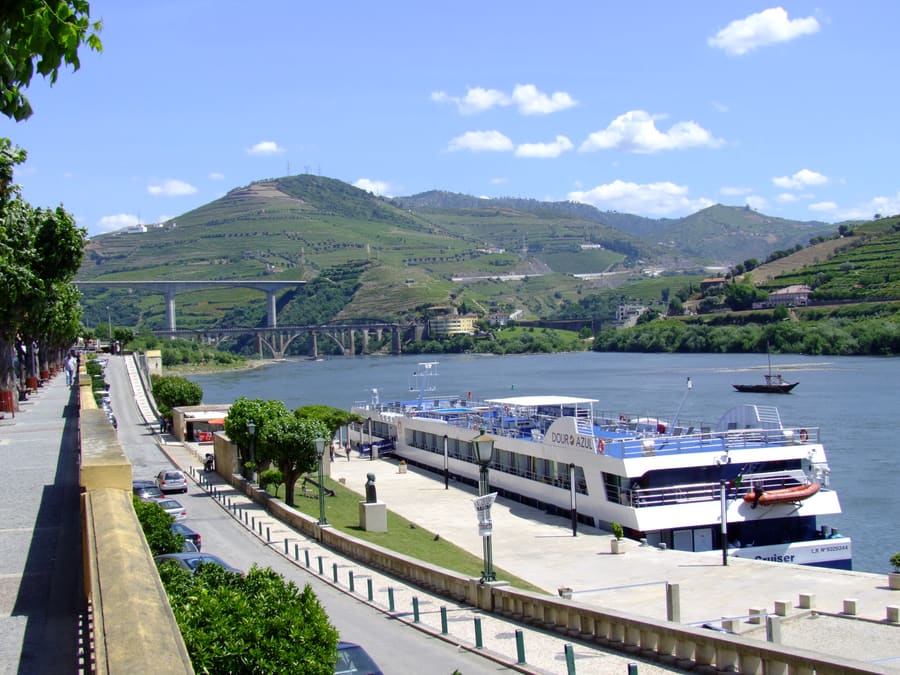
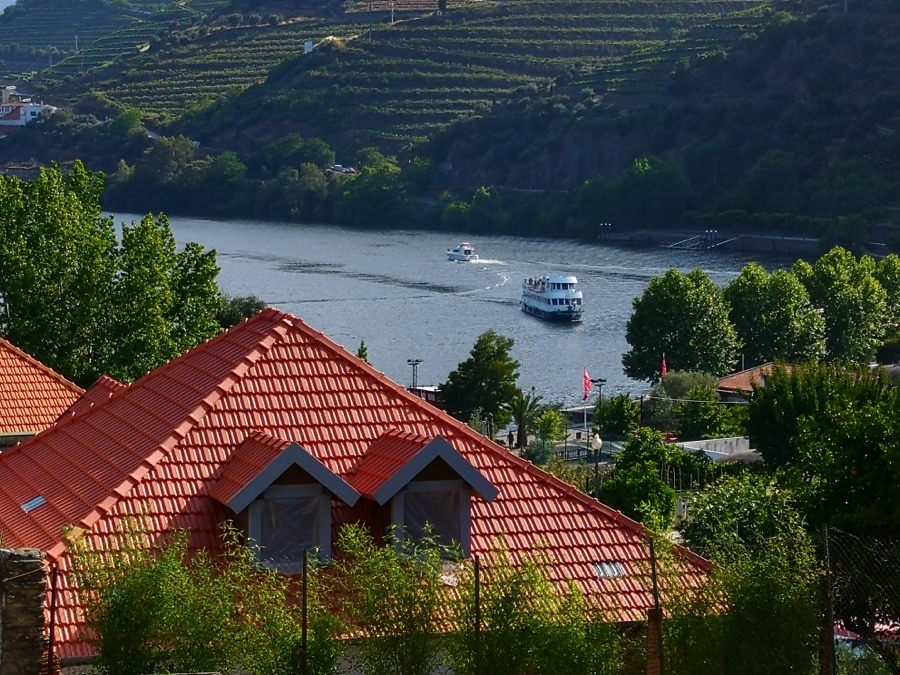
Each photo is geotagged in the town it names: Régua's riverside quay and Pinhão's rooftops by the station.

Peso da Régua riverside promenade and quay with a moored river-cruise boat, the Douro and terraced hills behind
Peso da RéguaThe riverside promenade and the Cais da Régua, with a river-cruise boat moored below the town.Photo: FWinkel / Wikimedia Commons, CC BY-SA 4.0. Taken on the quay, 41.1607° N, 7.7899° W (2010).
Pinhão rooftops above the Douro with a river boat passing and terraced vineyards on the far bank
PinhãoRooftops above the station, the Douro and the terraced slopes facing the village.Photo: Sanjorgepinho / Wikimedia Commons, CC BY-SA 4.0. Taken near the station, 41.1912° N, 7.5449° W (2019).
Rail, river and town

What each base gives you, checked against official sources.

Train counts, quay positions and lock dates change; recheck the dated source before booking.

What each base gives you, checked against official sources.
ComparePeso da RéguaPinhão
Trains from PortoChecked with Comboios de PortugalThe busier stop: about a dozen arrivals a day in CP's timetable valid since 5 August 2026, a few with a change at Marco de Canaveses. Direct trains take roughly 1 h 50 min, and several end their run here, including the latest evening trains.About half as many: around six arrivals a day, mostly the direct trains continuing to Tua and Pocinho, roughly 2 h 15 min from Porto Campanhã. The last arrival of the evening is earlier than Régua's.
Historic trainChecked with Comboios de PortugalCP's Douro Historical Train starts and ends at Régua station and runs to Tua and back on published June–October dates, the last in 2026 on 18 October; in 2026 its historic carriages are diesel-hauled.The train passes Pinhão and, on the return from Tua, stops there so passengers can see the station tiles; the programme itself starts and ends at Régua.
River boatsChecked with Administração dos Portos do Douro, Leixões e Viana do Castelo · Turismo de Portugal · Turismo do Porto e Norte de PortugalThe Cais da Régua (APDL km 101) lies below the Régua lock, on the stretch that boats from Porto reach after the Crestuma-Lever and Carrapatelo locks. Visit Portugal suggests Régua as a starting point for combining boat and train.Pinhão's quays (APDL km 124) sit above the Régua lock, about 23 river kilometres upstream. Porto and the North lists Pinhão as one of the region's three Douro docks; check each operator's own trip and pontoon.
Winter 2026–27 locksChecked with Administração dos Portos do Douro, Leixões e Viana do CasteloAPDL has scheduled the Carrapatelo lock to close from 2 December 2026 and Crestuma-Lever from 3 December to 21 March 2027, so boats from Porto cannot reach Régua in that window.The Régua lock is scheduled to close from 4 January to 21 March 2027, cutting the boat link between Régua and Pinhão. APDL warns the dates may move.
Station, quay and townChecked with Administração dos Portos do Douro, Leixões e Viana do Castelo · Museu do Douro · Turismo de Portugal · Câmara Municipal de AlijóA city and municipal seat. The station and the Cais da Régua are about 600 m apart in a straight line, with the Museu do Douro beside the quay. Expect more choice of rooms, meals and everyday services.A village of about 620 residents. The station and the Cais do Pinhão are about 200 m apart, so train and boat stay on foot; rooms on the surrounding slopes usually need a transfer.
Wine geographyChecked with Instituto dos Vinhos do Douro e do Porto · Turismo de PortugalAt the mouth of the Corgo, where IVDP ends the Baixo Corgo sub-region: the downstream, Baixo Corgo side of the valley.Inside Cima Corgo, which IVDP extends upstream from Régua. Many estates are on the slopes around the village; they are still a drive or transfer, not a platform walk.
Between the twoChecked with Comboios de Portugal · Infraestruturas de PortugalAbout 25 minutes by train to Pinhão, or 27 km on the EN222 along the river.The same link back to Régua; on a short trip, visit the other town for half a day instead of moving luggage.
Match the base to the trip

Which base suits which trip?

Start from how you will arrive and what the days are for. The base follows.

No car, Porto by train

Régua

Roughly twice the daily trains to and from Porto, including later evening arrivals, keeps a rail-only plan forgiving.

Boat from Porto one way

Régua

Boats from Porto reach Régua after two locks; sleeping there avoids another transfer that evening. Not possible from 2 December 2026 to 21 March 2027 while the locks close.

Historic train day

Régua

The programme starts and ends at Régua station on CP's published dates, so a Régua room avoids an extra train each way. CP's 2026 runs end on 18 October; check CP for the next season's dates.

Quinta visits and a quiet evening

Pinhão or a nearby quinta

Staying in Cima Corgo shortens estate transfers and gives the valley evening back. Confirm dinner, check-in and every estate arrival before booking.

Driving the valley

Either, by evening

The EN222 links the towns in 27 km. Take Régua for more evening choice or Pinhão for shorter drives to Cima Corgo estates, and keep the driver off the tastings.

One day from Porto

Stay in Porto

Use Régua as the turnaround for more trains back, or Pinhão if about 25 extra minutes each way buys the landscape you came for.

Stay comparison

Compare stays after choosing your Douro base

Use the same provider for both towns so price and availability do not distort the Régua-or-Pinhão decision.

Affiliate stay links: if you book through Stay22, EL Premier may earn a commission at no extra cost to you. Stay22 and its booking partners supply live prices and availability.

Practical answer

The essentials before you commit.

Use this quick read to confirm the fit, then open the questions that affect your trip.

Best for
Choosing a valley base by trains, river quays and evenings rather than by the classic photo alone.
Decide first
Rail flexibility and a full town in Régua, or a quieter Cima Corgo village night in Pinhão.
Verify
The dated CP timetable, APDL lock notices and the walk from station or quay to the room.
Frequently asked questions

Answers for a lower-friction decision.

Which base is more practical, Régua or Pinhão?

Régua, for most first trips without a car: CP's current timetable gives it roughly twice Pinhão's daily trains to and from Porto, it keeps later evening arrivals, and the town has more rooms and meals. Pinhão becomes the practical choice when the booked days are at Cima Corgo estates around it.

Do Douro trains leave from Porto São Bento?

Some do, but many direct Douro trains start at Porto Campanhã, and a few Régua services need a change at Marco de Canaveses. Read the departure station on the dated CP timetable or ticket and leave time to reach Campanhã.

Can I take a boat between Régua and Pinhão?

Boats can pass between the two quays through the Régua lock when it operates, but only an operator's dated programme makes that a usable link. APDL has scheduled that lock to close from 4 January to 21 March 2027.

Should I split the stay between both?

Usually not on a short trip. The towns are about 25 minutes apart by train, so visit the other one for half a day; split only when each base anchors a separate booked experience, such as a Régua boat arrival and Cima Corgo estate days.

Next decisions

Keep the valley plan coherent.

Move to the choice that changes the base, transport or booking sequence instead of restarting with a generic attraction list.

Base choice

Where to stay in the Douro Valley for a first trip

Choose between Porto, Peso da Régua, Pinhão, and a quinta stay by transport mode, wine plans, evening pace, and how deeply the trip enters the valley.

Read next

Rail planning

Douro Valley by train: build the day around the line

Use the official Douro Line to plan Porto, Régua, Pinhão, Tua, or Pocinho without turning a scenic rail day into an unverified chain of connections.

Read next

Advance planning

How to plan winery visits in the Douro Valley

Plan Douro quinta visits around advance confirmation, responsible transport, the difference between Port and Douro wines, and weather-led harvest timing.

Read next

Verify before booking

Current details belong to official sources.

Rail service, boat products, road conditions, estate visits, harvest programmes, and prices can change. This page gives the decision frame; official sources and operators must confirm the live facts.

Official checks
  • CP: Douro Line official timetableThe Douro Line timetable valid since 5 August 2026: about twice as many daily Porto trains reach Régua as Pinhão, several terminate at Régua, and many direct trains start at Porto Campanhã. Recheck the dated timetable and notices.Checked 2026-10-11
  • CP: Douro Line service noticesCurrent Douro Line service changes, engineering works, replacement transport and the latest official timetable notice.Checked 2026-10-08
  • CP: Douro Historical TrainThe seasonal Régua–Tua return programme with a stop at Pinhão, its diesel-hauled historic carriages and the published June–October dates; the last 2026 run is on 18 October.Checked 2026-10-11
  • APDL: Douro waterway berthing terminalsPositions of the Cais da Régua (km 101) and the Pinhão quays (km 124), used to compare each quay with its town and station.Checked 2026-10-02
  • APDL: Douro waterway locksLock order on the waterway: Crestuma-Lever and Carrapatelo between Porto and Régua, then the Régua (Bagaúste) lock between Régua and Pinhão.Checked 2026-10-02
  • APDL: Douro notices to navigationNotice 129/2026: lock maintenance closures until 21 March 2027, with Carrapatelo from 2 December and Crestuma-Lever from 3 December 2026, and the Régua lock from 4 January 2027; APDL warns the dates may change.Checked 2026-10-11
  • Porto and the North: nautical tourismRégua and Pinhão as two of the region's three Douro docks, and a short river cruise from the Régua pier as a suggested valley morning.Checked 2026-10-02
  • IVDP: characteristics of the Douro regionThe Lower Corgo ending where the Corgo meets the Douro at Régua, and the Upper Corgo (Cima Corgo) extending upstream from there.Checked 2026-10-02
  • Infraestruturas de Portugal: the EN222 Régua–Pinhão roadThe 27 km EN222 section between Peso da Régua and Pinhão, running parallel to the Douro.Checked 2026-10-02
  • Museu do Douro: visit and contactThe museum's riverside address and coordinates in Peso da Régua, beside the town quay.Checked 2026-10-02
  • Visit Portugal: Peso da RéguaRégua's historic role in the demarcated wine region and in the production and movement of Port wine.Checked 2026-09-07
  • Visit Portugal: The Douro ValleyOfficial destination framing for reaching the valley by road, train, or boat, plus Régua, Pinhão, viewpoints, and route-planning context.Checked 2026-09-07
  • Visit Portugal: Port and Douro Wine RouteThe demarcated wine region, its three sub-regions, transport modes, wine villages, and the need to arrange quinta visits in advance.Checked 2026-09-07
  • Municipality of Alijó: PinhãoPinhão's position at the Douro and Pinhão rivers, its wine-trade history, terraces, harvest traditions, bridges, station, and local identity.Checked 2026-09-07
  • Turismo de Alijó: Pinhão railway stationThe station's 24 tile panels, the phases of wine production they depict, and the station's role as cultural context rather than just a transport stop.Checked 2026-09-07

What this guide cannot replace

DouroValley.app explains the durable decision. It does not replace a current timetable, an estate confirmation, road instructions or a sober transport plan.

Read the method